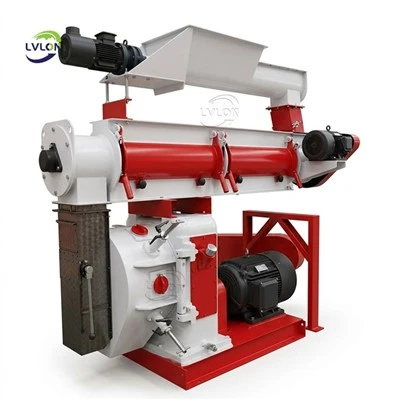
Lvlon is a machinery manufacturer in Henan, China, building the 1000kg biomass straw pellet production line for farm waste processors, biomass fuel plants and feed mills across Asia, Africa and Latin America-the agricultural regions where crop straw is everywhere. As the factory, we supply wholesalers, bulk buyers, distributors and agents directly-no middle layer. In-house fabrication of every stage. One supplier, one warranty. OEM/ODM on die size and configuration, with your brand or specification. Spare parts stocked and air-freighted in 5–15 days.
The Straw Problem, Solved as a Product
Open-field burning of crop straw is banned across most of the agricultural world-and the straw still has to go somewhere. The pellet line turns that liability into inventory: corn stalk, rice straw, wheat straw, cotton stalk-loose, low-density agricultural waste-becomes standardized, high-density pellets that burn cleanly in household heaters, industrial boilers and power plants, or feed cattle and sheep as high-density fodder pellets. The farmer's disposal problem becomes the processor's product.
Five Stages, Configured for Straw
Straw is not wood. It is loose, fibrous and arrives wet-the line's preparation stages are tuned for exactly that behavior.
| Stage | Equipment | Power | Rating |
|---|---|---|---|
| Grinding | HM500 hammer mill | 22 kW | 900–1000 kg/h |
| Drying | GX100 drum dryer (Ø1m × 10m) | 4+7.5+0.75 kW | 0.8–1 t/h |
| Pelletizing | MZLH420 ring die mill (die Ø420mm) | 90+2.2 kW | 1 t/h |
| Cooling | SKLN1.5 counterflow cooler (1.5 m³) | 0.75+1.1 kW | 3 t/h, 6–10 min |
| Packing | WDCS-50 packer | 2.2 kW | 3–4 bags/min, 5–50 kg |
The hammer mill grinds straw fiber to the fineness where pellets actually form. The drum dryer-the right dryer choice at this capacity-drops moisture into the forming window. The ring die mill compresses the prepared material through the die under high pressure and cuts it into pellets. The counterflow cooler hardens the hot pellets so they store and ship without deformation. The packer seals them against dust and moisture for a long storage life.
Gear Drive: The 20% That Shows in Production
The pellet mill is driven by a gear transmission instead of belts. Under heavy load, belts slip-power is lost and belts wear. Gear drive is a rigid connection: power reaches the die without slipping, which is why the line delivers roughly 20% more production efficiency than belt-driven equivalents. Over a full production year, that is both a throughput difference and an electricity difference-the kind of number an operator sees on the meter and in the output pile.
One Line, Two Markets
The same pellets serve two buyers. Biomass fuel pellets for household heating, industrial boilers and power plants-the clean substitute for coal in emission-regulated markets. Livestock feed pellets from forage, alfalfa and straw-high-density cattle and sheep feed. The line's product direction follows local market prices, and the feedstock base-four major crop straws-is available in every agricultural region. That flexibility is what makes the line a standard investment in farm belts, not a niche machine.
FAQ
Q: Straw pellet line or coconut shell pellet line?
Raw material and capacity differ. The coconut shell line runs 500 kg/h with an airflow dryer and a choice of ring or flat die-for coconut-producing regions and smaller investment. This line runs 1000 kg/h with a drum dryer and a 90 kW gear-driven ring die mill, configured for straw fiber-corn, rice, wheat and cotton stalk. Agricultural regions with crop waste: this line.
Q: Fuel pellets or feed pellets?
Either. Biomass fuel pellets for household heating, boilers and power plants, or high-density cattle and sheep feed pellets from forage, alfalfa and straw-choose by local market price. Feedstock covers four major crop straws, so the line fits any agricultural region.
Q: Why gear drive instead of belt?
Belts slip under heavy load-lost power and belt wear. Gear drive is a rigid connection: power reaches the die undiminished, roughly 20% more production efficiency. The trade-off is regular gearbox lubrication and inspection.
Contact Lvlon for the complete line quotation, plant layout drawing and container loading plan.