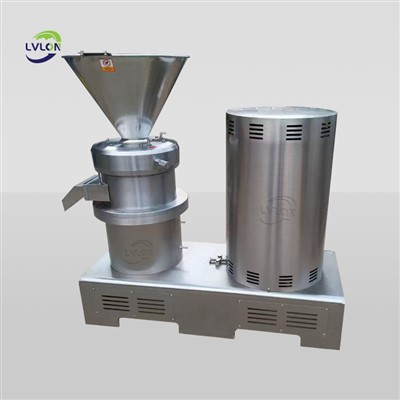
If you've spent any time working with food, pharmaceutical, or cosmetic production lines, you know that the colloid mill homogenizer is the workhorse behind consistent, fine particle sizes and stable emulsions. As a supplier of industrial processing equipment, I've talked to dozens of plant managers and production supervisors who tell me their colloid mills deliver great results today-but they're hungry to boost their automation level to cut down on manual labor, reduce waste, and keep up with growing demand. The good news is that improving automation for this core piece of equipment doesn't have to mean a full, costly replacement. With targeted upgrades and smart process adjustments, you can turn a semi-automatic colloid mill homogenizer into a more efficient, hands-off asset that works harder for your bottom line.
First, let's ground this in why automation matters specifically for colloid mill homogenizers. Unlike simpler processing equipment, colloid mills rely on precise adjustments to rotor-stator gap size, motor speed, and feed rates to control particle size distribution, viscosity, and emulsion stability. A manual setup requires operators to check these variables constantly, tweak settings mid-run, and manually load/unload materials-steps that lead to human error, inconsistent batches, and even safety risks when working with high-volume or abrasive materials. For reference, many adjacent pieces of processing equipment have already made this shift: you can see this in how modern bone crusher machines or industrial spice grinders integrate real-time sensors to adjust for material density, and the same logic applies to colloid mills.
The most impactful first step to automating your colloid mill homogenizer is upgrading its control system from a manual or basic analog setup to a programmable logic controller (PLC) paired with human-machine interface (HMI) software. I've seen plant managers skip this step and regret it later-without a central control hub, you can't sync the mill with upstream or downstream equipment, or store repeatable settings for different recipes. For example, a chocolate manufacturer might run three different batch sizes with varying particle size requirements; a PLC-HMI system lets you save each recipe's rotor gap, speed, and feed rate settings, so you don't have an operator guessing or adjusting wrong between runs. This also lets you add remote monitoring, so you can check mill performance without standing next to the unit 24/7. The best part? Most modern PLCs are compatible with existing colloid mill units, so you don't have to buy a whole new machine if your current unit is in good shape.
Next, you'll want to automate material feed and discharge-two of the most labor-intensive parts of colloid mill operation. Manual feeding means operators are manually pouring or scooping raw materials into the mill's hopper, which is slow and can lead to overfeeding (causing jams) or underfeeding (wasting motor power). Automating this means adding a volumetric or gravimetric feeder that syncs with your PLC to deliver a precise, consistent amount of material per minute. Gravimetric feeders are even better for high-precision applications, like pharmaceutical suspensions, because they measure weight in real time and adjust feed rates on the fly if material density changes. For discharge, you can integrate a pump or conveyor system that automatically moves processed product to the next stage-whether that's a mixing tank, packaging line, or storage bin. This not only cuts down on manual lifting and handling but also eliminates the risk of cross-contamination between batches, which is a huge win for food and pharma manufacturers.

A common pain point that many plant managers overlook is gap adjustment automation. The rotor and stator inside a colloid mill are separated by a tiny gap-usually just fractions of a millimeter-that directly impacts particle size. Adjusting this gap manually with a handwheel is imprecise; even a 0.1mm difference can make a batch of lotion too thick or a sauce too lumpy. Automating gap adjustment means adding linear actuators that the PLC controls, so it can tweak the gap in real time based on feedback from sensors. Pair this with particle size analyzers that measure product consistency as it exits the mill, and you've closed the loop: the sensor sends data back to the PLC, which automatically adjusts the gap to keep particle size within your target range. I recently worked with a BBQ sauce producer who upgraded this on their existing colloid mill homogenizer, and they reported a 30% drop in batch rejections because of inconsistent texture-numbers that speak for themselves. If you're familiar with other automated grinding equipment, this is similar to how modern powder grinding mills adjust grinding chamber settings automatically, and the same engineering applies here.
Don't sleep on integrating safety and condition monitoring as part of your automation upgrade. Colloid mills work at high speeds, and running them incorrectly can lead to excessive wear on parts like the rotor, stator, or seals. Adding vibration sensors, temperature probes, and torque monitors lets the PLC track real-time conditions: if the motor is running too hot, or vibration levels spike (a sign of a misaligned rotor or worn bearing), the system can automatically slow the mill or shut it down to prevent damage. This not only extends the life of your equipment but also keeps operators safe by reducing the need for manual checks during runs. Many of these safety integrations are easy to add to existing machines, so you don't have to start from scratch to get this benefit.
Once you've made these individual upgrades, the final step is syncing your colloid mill homogenizer with your full production line's management system. This is called Industry 4.0 integration, and it's the difference between a semi-automated mill and a truly automated process. For example, if your upstream mixing tank is ready to send raw material, it can send a signal to your colloid mill's PLC, which starts the feed system and gap adjustment automatically. After the mill finishes processing, it sends a signal to your packaging line to start filling and sealing containers, no operator intervention needed. This level of sync doesn't just save labor-it reduces changeover time between batches, because the system can automatically adjust all settings when you switch from one recipe to another. If you're looking for a full line-up of industrial processing equipment that works in sync, our range of colloid mill homogenizers and adjacent processing tools are designed to integrate seamlessly with existing line controls.
Of course, every production line is different, so it's important to tailor these upgrades to your specific needs. A small craft bakery might not need a full PLC overhaul, but a basic HMI that stores recipe settings and a gravimetric feeder could cut their manual work in half. A large pharmaceutical plant, on the other hand, might need full particle size monitoring and integration with their batch record-keeping system for compliance. That's why as a supplier, I always recommend starting with an audit of your current process: map out where your bottlenecks are, how much manual labor is involved, and what your quality targets are. This will help you prioritize which automation upgrades will give you the biggest return on investment, whether that's gap adjustment automation, feed systems, or full line sync.
If you're ready to take the next step, the best way to start is by reaching out to our team to discuss your specific needs. We've helped dozens of manufacturers boost their colloid mill automation levels, and we can provide a customized quote, answer questions about compatibility with your existing equipment, and walk you through which upgrades will work best for your production goals. Our focus is on practical, cost-effective solutions that deliver real results, not just the latest buzzwords, so you can upgrade your equipment without breaking the bank.
References
- Food and Drug Administration (FDA). (2021). Current Good Manufacturing Practices (CGMP) for Finished Pharmaceuticals. U.S. Department of Health and Human Services.
- Society of Petroleum Engineers (SPE). (2019). Automation in Industrial Processing: Best Practices for Particle Size Control.
- International Organization for Standardization (ISO). (2020). ISO 22000: Food Safety Management Systems – Requirements for Any Organization in the Food Chain.
- Colloid Mill Technology Association. (2022). Guide to Modernizing Colloid Mill Homogenizer Operations.