



Last October, a feed producer outside Cali, Colombia called us about their grinding line. Rainy season had settled in, and output had slid from 6 t/h to barely 4 t/h - thirty percent gone - on the same screen, the same recipe, the same sifter. Morning meetings had turned into arguments about who was breaking the machine. Nobody was breaking anything. The machine was doing exactly what the process asked of it: taking in more grain than it could push out, because grain at the intake pit was running two to three points wetter than it had in August. The mill itself was fine - the moisture had shifted the throughput balance.
That distinction is the whole article, so here is the judgment up front: if your mill jams on rainy days and runs clean in the dry season, stop reading and check your moisture. For everyone else - capacity that fades for no obvious reason, plugs at random hours, chambers that pack after a recipe change - read on. A mill loses its balance in three places, and only one of them lives in the grinding chamber.
Two Diseases, Two Exams
Before starting work, decide which problem you are treating. A mill that has been slowly losing capacity for weeks needs different work than a chamber that packed mid-shift.
| What you're seeing | The disease | Most likely culprit | First check |
|---|---|---|---|
| Capacity slides over weeks; amperage creeps up; mash runs coarser | Progressive decay - grinding energy quietly lost | Hammer corner wear, tip speed down; screen partly blinded | Hammer corners against the wear limit; your output trend log |
| Sudden jam mid-shift, chamber packed solid | Acute overload - inlet beat outlet in minutes | Wet grain surge, runaway feeder, or screen blinded by damp fines | Moisture of the grain at the intake; screen condition after clearing |
| Jams cluster on rainy days, runs clean when dry | Chronic moisture-driven blinding | Grain above ~14% moisture; condensation in storage | Moisture meter, several points across the pit |
| Plug arrives mid-run, no recipe change, no weather change | Downstream backpressure | Counterflow cooler near full, bridged auger, choked airlock | Walk the line from the cooler backwards before opening the mill |
| Motor hums or trips instead of the chamber packing | Not a process problem at all | Electrical/control territory | See our guide: pellet mill motor trips breaker on startup |
The Throughput Balance: Why Wet Grain Eats Your Capacity
Every mill obeys the same conservation law as any other process: whatever enters the grinding chamber must exit through the screen, every second, or it accumulates. Feed rate above discharge capacity is inventory, and inside a hammer mill that inventory is a plug. Nobody sets out to overfeed a mill. What happens instead is that the discharge side loses capacity gradually until the unchanged feed side exceeds it.
Moisture is the biggest lever on the discharge side. Around and above 14%, ground grain stops flowing freely and turns plastic: particles just below the screen aperture wedge into the holes, and damp flour smears over the wedged ones. The hammer mill screen open area collapses from the inside - that is screen blinding with fines, and from the control room it looks exactly like a capacity problem. That was the Colombian case: same screen, same recipe, wetter grain. The screen was still correctly sized; there was just less of it available every hour. If you're asking about the safe moisture content for grinding grain in a hammer mill, 14% is the working ceiling for most cereals, and throughput is already penalized a point or two below it.
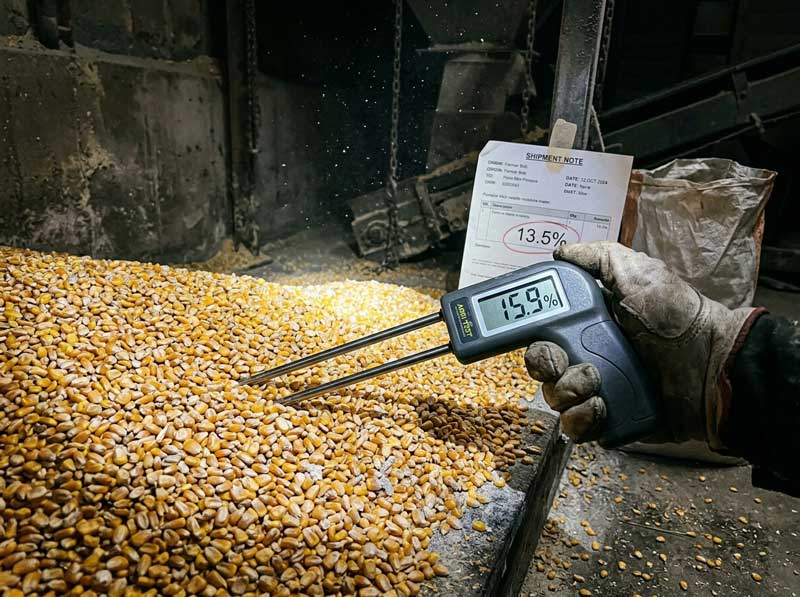
Two quieter factors blind screens as well: dust and chaff off a dirty intake blind apertures faster than anything else, and oil-rich materials like full-fat soybean smear a screen even when bone dry - choose your screen open area with both in mind.
Hammer wear and tip speed loss
Nine times out of ten, a "hammer mill capacity dropped suddenly" report is the last visible step of a decay that has been running for weeks. Tip speed sets the grinding energy: v = π × D × n / 60. For a Ø600 mm rotor at 2,970 rpm, that is π × 0.6 × 2,970 ÷ 60 ≈ 93 m/s at the tip. At 93 m/s a hammer doesn't rub grain into flour - it shatters kernels against the screen. Wear the corners back and the energy per strike falls, so the mash comes out coarser.
Coarse product doesn't leave, though. Oversize particles recirculate inside the chamber until they are small enough to pass, so hammer wear loads the chamber twice - less grinding energy coming in, more material staying in. Amperage climbs while output falls, the feeder keeps pushing, and one damp hour later the chamber packs solid. Plot amperage and output together: output down, amperage up, mash coarser - that pattern points at hammer wear rather than grain quality.
Run a hammer rotation schedule for even wear - flip or rotate the set on a fixed hour interval matched to your material's abrasiveness, and replace the full set when corner loss reaches the OEM wear limit. A half-worn set grinds unevenly and overloads the worn hammers you keep. Track the trend as well: log kg/h every shift and treat a 10% decay as the early warning that schedules your hammer replacement - otherwise the replacement happens mid-shift, under full load.
How hammers are laid out and weight-matched on the rotor affects balance and vibration more than throughput, so we cover it separately in the hammer mill hammer pattern and weight matching guide.
Airflow and Downstream: A Mill Is Also an Air Pump
A mill is also an air pump: restrict the draft and the chamber floods with material it cannot discharge. Hammers do the breaking, but the draft does the removing: air pulled through the aspiration plenum under the chamber drags finished fines through the screen apertures and away to the cyclone. Without draft, fine material has nowhere to go even when it is small enough to pass the screen.
So when a mill that ran clean yesterday packs today, read the air path before blaming the screen. Three checkpoints. First, the pulse jet filter bags: watch the differential pressure gauge across them - a climbing ΔP means blinded bags, blinded bags mean no draft at the mill, and no draft means finished flour sits at the screen. Second, the rotary airlock at the mill base: if its clearance has worn open, air takes the shortcut through the leak instead of pulling through the screen, and aspiration stops even though the fan is still running. Third, ducting and cyclone: a collapsed hose, a shifted bag, a cyclone discharging against a full bin - any of them cuts the draft.
Downstream equipment can cause the same symptom. A counterflow cooler near the top of its fill, or a discharge auger starting to bridge, pushes backpressure up the line until the mill discharge backs up and the chamber packs. Any plug that arrives mid-run with no recipe change and no weather change - walk the line from the cooler backwards before you open the mill. We've chased more than one "clogged mill" that turned out to be a full cooler.
The last piece of the balance is the feeder. A variable-speed feeder with amperage control closes the loop: calibrate the kg/h–amperage curve once so the operator knows exactly what 85% load looks like on the gauge, and keep 15% headroom for wet surges. When damp grain arrives, the operator - or better, an interlock - trims the feed before the chamber packs.
The Screen–Hammer–Airflow Triangle Checklist
When output drops or the chamber packs, walk the triangle in this order. Most faults surface before you finish the third checkpoint.
| Point | Check | Healthy reading | If it's out of spec |
|---|---|---|---|
| Screen | Backlit open area after each shift; aperture vs target mash particle size; screen tension across the frame | Clean apertures over the full surface; even, drum-tight seating with no ripple | Flip or brush the screen (never compressed air toward open ports); replace when open area loss passes ~10% or apertures run oversized |
| Hammers | Corner rounding and edge wear vs OEM limit; rotation hours kept; wear spread across the set | Fresh-ish corners, uniform wear, rotation done on schedule | Rotate or flip the set; replace the full matched set at the limit; never mix worn and new hammers |
| Airflow | ΔP across the filter bags; draft at the plenum and mill base; airlock leakage; cyclone discharge | ΔP inside the bag maker's band; steady draft; airlock turning freely and sealing | Pulse or replace bags; restore airlock clearance; clear ducting and cyclone; verify draft with an anemometer |
How to Clear a Jammed Hammer Mill Safely
- Lock out everything. Apply LOTO to the mill main drive, the feeder, and the aspiration fan - not just the mill. Wait for the rotor to spin down completely; a Ø600 mm rotor carries real momentum.
- Open and read the chamber. Find where it packed. The usual suspect is the last third of the screen arc, where fines blind first and material bridges first.
- Bar the rotor around. With locks still in place, rotate the rotor with a pry bar on the sheave and let packed material fall as it turns. Work it loose with hooks and rods from outside the chamber - never hands. If the bar won't turn the rotor, the pack is structural: clear it from the screen side and try again.
- Judge the screen honestly. Brush the apertures clean, flip the screen if wear allows, and replace it when open area loss passes ~10% or the holes run oversized - an enlarged screen makes coarse mash forever. Reseat with proper screen tension so it can't flutter.
- Clear the path out. Confirm the rotary airlock turns freely, the cyclone discharges, and the downstream auger and cooler are open before you even think about restarting.
- Restart empty and ramp. Close up, restore locks per your LOTO procedure, start with an empty chamber, then bring the variable-speed feeder up over several minutes while watching amperage. A chamber restarted under load re-packs before you finish the ramp.
The five instruments that make the diagnosis
Five instruments cover most of the diagnosis. Push a moisture meter into the grain at the intake - several points, every shift in the wet season - because that one number explains most rain-driven clogs. Verify actual rotor rpm against the nameplate with a tachometer after any belt or VFD change, since tip speed math is only as good as the rpm it is built on. Check draft at the plenum and the mill base with an anemometer to confirm aspiration is still moving air. Read the differential pressure gauge across the filter bags as the leading indicator for the aspiration system. And put a clamp meter on the mill circuit to watch load in real time against your kg/h–amperage calibration curve.
Prevention
Control moisture at the gate. Test every incoming lot, dry to ≤14% before it reaches the mill, aerate storage to eliminate condensation pockets, and rotate stock so the wettest grain is not ground during peak production. Interlock the feeder to amperage as well: let the feeder follow the main drive amps so that, as load climbs toward your 85% line, feed trims automatically and the chamber never reaches its limit.
Keep the output trend on the wall. Log kg/h per shift with one week visible, and treat a 10% decay as your scheduled window for hammer and screen service rather than waiting for the breakdown. Empty before you stop. Cut the feed, run the chamber clear, then stop the mill. A mill left full bridges overnight: the flour settles, picks up moisture from the air, and the next shift starts with a plugged chamber.
Frequently Asked Questions
What is the safe moisture content for grinding grain in a hammer mill?Around 14% is the working ceiling for cereals like corn and wheat. Above it, blinding and capacity loss compound fast; well below it, you burn drying energy you didn't need to spend. Measure at the intake, not on the delivery ticket.
Why did my hammer mill capacity drop suddenly when nothing looks broken?"Suddenly" is usually the end of a quiet slide: worn hammer corners, a partly blinded screen, and tired filter bags each take a few percent until one wet hour tips the balance. Run the triangle checklist - the trend log will show the slide that "suddenly" hid.
How do I tell a blinded screen from a worn screen?Hold it to the light. Blinded: apertures plugged with flour, screen comes clean when dry grain runs, mash looks damp and coarse. Worn: holes enlarged or elongated, mash coarse even when the grain is bone dry. Blinding you brush out; wear you replace.
How often should hammers be rotated or replaced?On a fixed hour interval set by your material's abrasiveness, not by how they look at teardown. Flip or rotate at the interval, replace the full matched set at the OEM wear limit, and never mix old and new hammers on one rotor.
Can a problem after the mill really cause it to clog?Yes. A counterflow cooler filling to the top, a bridging auger, or a choked rotary airlock puts backpressure against the mill discharge, and the chamber packs. For mid-run plugs with no recipe or weather change, check downstream first.
Fix the Balance, Not the Plug
A clogging mill tells you one thing about your process: intake beats discharge. Pull the plug and you have cleared a symptom, not the cause. Restore the moisture, the tip speed, and the draft, then calibrate the feeder to sit at 85% load, and the plugs stop coming back because the balance holds. Same machine, same recipe, same screen. That's what fixed the Colombian line, and it fixes most lines like it.
Send the Lvlon service desk three numbers - your screen aperture, today's grain moisture reading at the intake, and the last week of amperage trend - and we can usually identify the cause from those three numbers.


