


Pellet Mill Bearing Overheating: Why "Add More Grease" Makes It Worse
Last month, an Ecuadorian client running our 420 pellet mill called with a complaint we could recite from memory: the pellet mill bearing temperature alarm keeps tripping, always at about the same point in the shift. The duty operator had a routine he was proud of. Every time the alarm sounded, he gave the bearing two more shots from the grease gun on the remote lubrication line. The alarm quieted for a few days, then came back a little higher each time. When we asked what the housing actually read, he said 92 °C. When we asked how full the cavity was, he paused. Full. He had made sure of it.
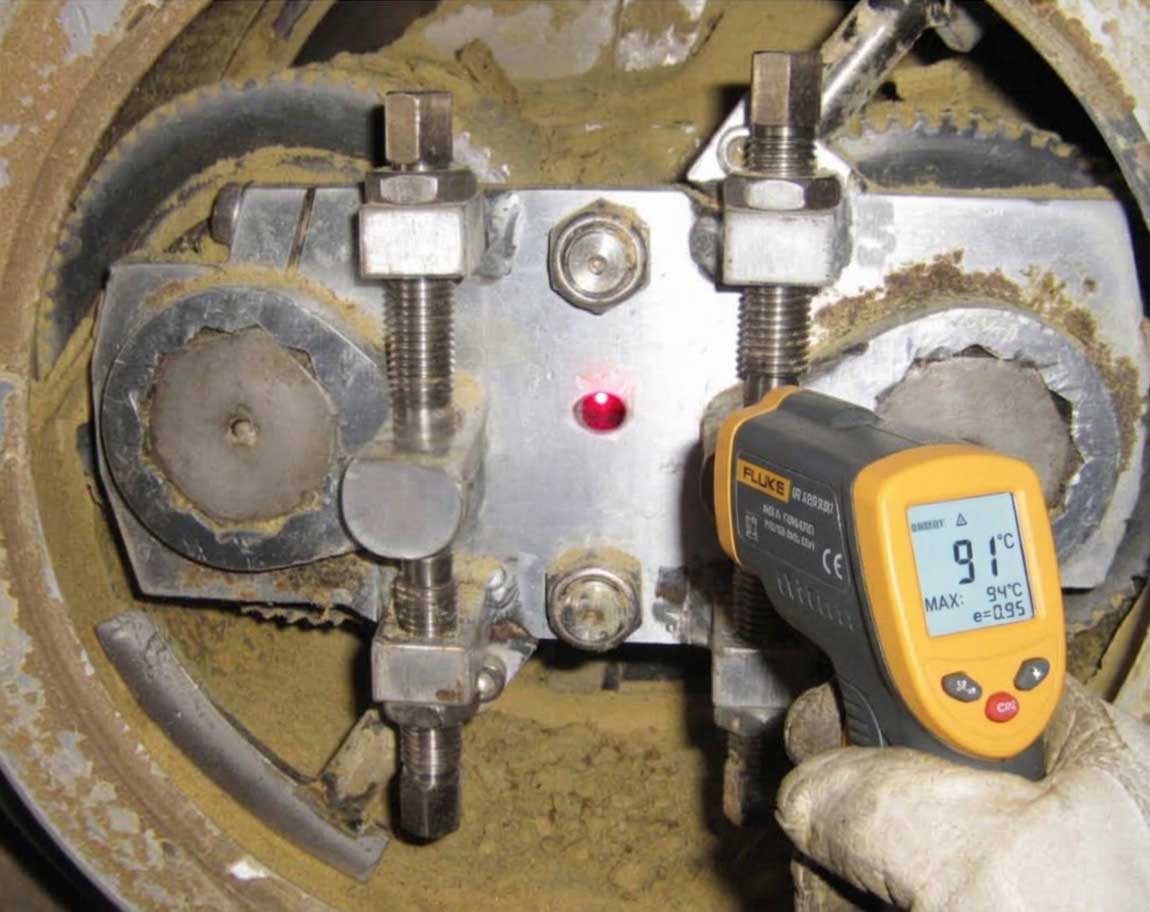
That call is why this article exists. More grease is the most expensive "cheap fix" in a feed mill: it costs nothing, it feels disciplined, and in our service logs it causes most pellet mill bearing overheating calls rather than curing them.
Can over greasing cause bearing overheating? Yes - it is the most common cause we find. Rollers pushing through a cavity packed 70–80% full shear grease into heat faster than the housing can shed it. The telltale sign is timing: a housing that climbs 10–15 °C within 30–60 minutes of greasing is over-filled. Purge, then refill to the speed-class quantity - a medium-speed (1500–3000 rpm) main shaft bearing takes 30–50% of the free cavity, roughly 130–200 g on a 22218 - and hold the housing under 70 °C. Above 95 °C, or more than 40 °C above ambient, stop the machine.
When a Bearing Temperature Becomes a Stop Signal
Housing temperature is the one number every feed plant already collects, and the one number most plants act on too late. These are the thresholds we train operators on at commissioning:
| Housing temperature | What it means | What to do |
|---|---|---|
| Below 70 °C | Normal operating band | Log it and trend it; nothing else needed |
| 70–85 °C | Elevated - friction or a heat-dissipation problem is developing | Start daily checks: grease condition and fill, belt tension, roller gap |
| 85–95 °C | Abnormal - the oil film is at risk | Reduce feed rate immediately to unload the bearing, then diagnose |
| Above 95 °C, or more than 40 °C above ambient | Critical | Stop the machine now - above 95 °C mineral grease oxidizes rapidly and raceways can deform permanently |
Two reading notes. The "ambient plus 40" rule matters most in tropical plants: a housing at 72 °C in a 28 °C mill room is carrying a 44 °C rise and has already crossed the line, even though 72 looks fine on paper. And the 85–95 °C band is where you still get to choose - cutting the feeder rate, even for an hour, unloads the bearing and protects the oil film while you diagnose. Past 95 °C the choice is made for you. That is how a grease question becomes days of pellet line unplanned downtime.
The heat balance inside the housing
A running bearing is governed by a simple heat balance. Heat comes in through contact friction, shear in the grease, and whatever load the machine pushes through the shaft; heat leaves by conduction into the shaft, housing, and frame. Housing temperature is simply the net result of the two. A pellet mill main shaft bearing runs warm by nature: it carries the full pressing load, sits near a die radiating friction heat, and usually gets mediocre airflow.
Grease is not a coolant: it is one of the poorer heat paths in the housing. Adding grease does not add cooling - it adds mass the rollers must push aside on every pass. Push the fill past 70–80% of the free cavity and a running bearing spends real energy churning that grease instead of carrying load, and every watt of it becomes heat inside the housing; in most cases a housing that will not cool down is over-filled, not under-filled.
Bearing catalogs still print the old volume formulas - 0.114 × D × B and their cousins - but they only estimate a cavity's geometric capacity. They have no opinion on shaft speed, and speed is what actually decides the fill. So we fill by speed class, not by volume.
Three causes behind most overheating calls
A dozen things can heat a bearing: a wrong fit, contamination, end-of-life spalling, a clearance never right for the running temperature. In daily plant work, three causes cover most of our alarm calls. Work these first.
1. Too Much Grease, by Far the Most Common
We see this in almost every second plant we visit. The maintenance team believes they are extending bearing life; they are cooking the bearing in grease. The churning described above leaves a pattern you can catch without instruments: a housing that climbs 10–15 °C within 30–60 minutes of a grease event is over-filled. A temperature that drifts up over weeks has some other cause; a step up right after greasing comes from the grease gun.
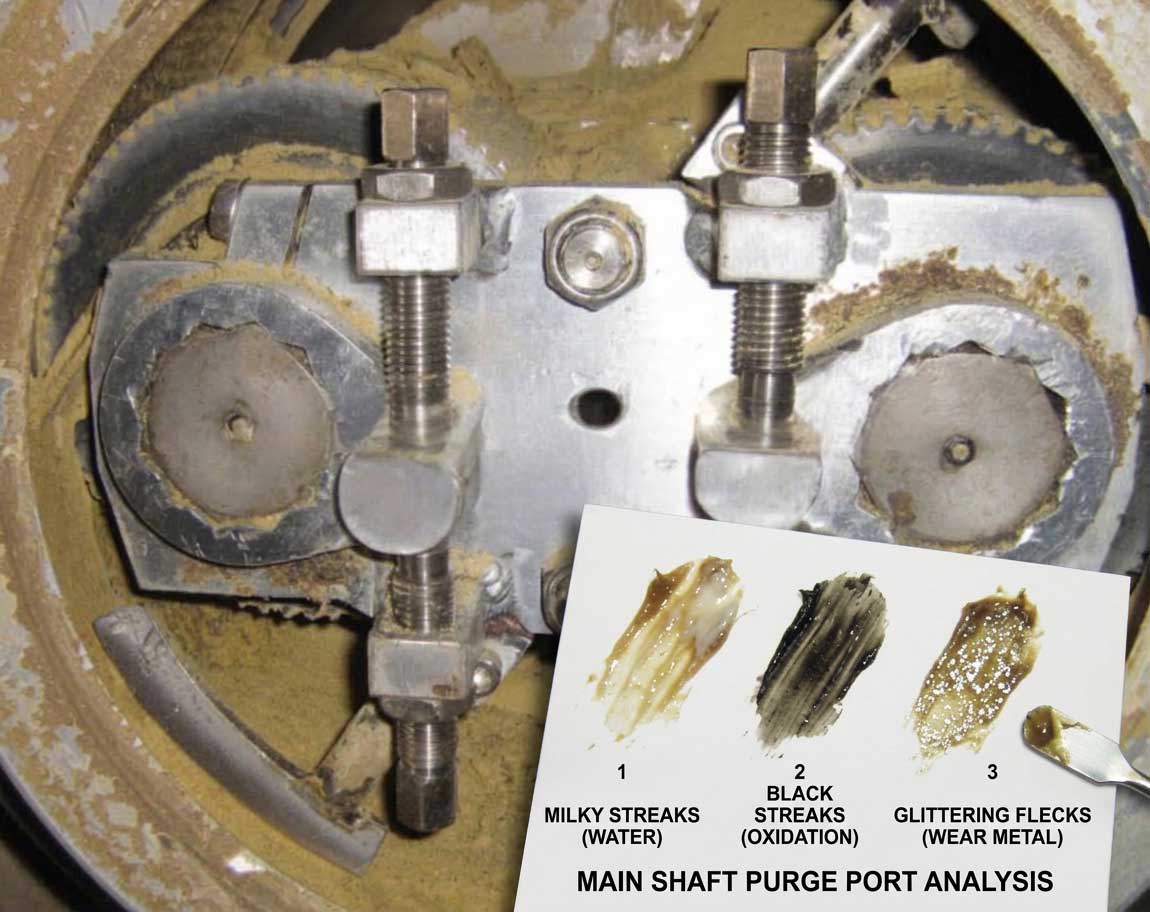
The purge port adds a second free diagnostic. Wiped on a white card, the spent grease can be read directly: milky white means water has emulsified the thickener - suspect washdown spray, a tired seal, or conditioner steam leakage along the shaft; black and crumbly means oxidized grease, from running hot or from product that sat in the cavity far too long; metallic glitter means wear metal from raceways or rollers, and the right response is an inspection rather than another grease change.
The fix for over-filling is not "use less next time." It is a complete purge, then a refill to the quantity the speed-class table calls for.
2. Mechanical Load: Tight Belts and a Starved Die-Roller Gap
If temperature tracks machine load - climbing hard at full production, easing at idle, indifferent to greasing - stop blaming the grease and look at what the bearing is carrying. Two everyday adjustments feed radial force straight into the main shaft bearings.
The first is belt tension: a drive belt cinched beyond the manufacturer's deflection spec acts like a spring dragging the shaft toward the motor on every revolution, all shift long. The second hides in the die chamber: when the die and roller clearance is pressed below the 0.1–0.3 mm standard, the rollers stop rolling the meal and start pressing the die itself, preloading the main shaft bearings turn after turn - the same punishment a wrongly machined fit would deliver. The oil film thins under that load, and the housing climbs with it.
Both checks cost minutes: rotate a feeler gauge between roller and die face, pull each belt with a tension gauge against the drive spec, and compare both against your alignment and die-change records. If vibration trend data exists, it corroborates the story - a load-following temperature with rising vibration is a preload signature, and our guide on why does my feed pellet mill vibrate shows how to read it.
3. Fill by Speed Class, Not by Feel
Grease quantity is not one number; it is a function of speed. A slow, heavily loaded bearing tolerates a fat cavity because each roller visits a given zone rarely. Spin the same shaft faster and even a half-full cavity churns. This table is the fill schedule we ship with Lvlon machines and teach at commissioning:
| Speed class and duty | Housing cavity fill | Total grease in a 22218 (estimate) | Typical equipment |
|---|---|---|---|
| Low speed, heavy load - below 1500 rpm | 50–70% | 200–280 g | Mining machinery, heavy-duty gearboxes, conveyor idlers |
| Conventional medium speed - 1500–3000 rpm | 30–50% | 130–200 g | Industrial fans, standard electric motors - most pellet mill main shafts sit here |
| High speed - above 3000 rpm | 25–30% | 110–130 g | High-speed centrifuges, precision exhaust fans - the hammer shaft on your grinder runs here |
A 22218 on a pellet mill main shaft almost always lands in the medium-speed row. The hammer shaft on the grinder next door sits in the high-speed row and wants a visibly smaller fill - same plant, same grease, different quantity. That is why every lube point carries its own tag.
Four disciplines make the table work. At installation or rebuild, pack grease into the element clearances and between the rollers completely, but fill the housing cavity to only one-third - the rest is churn space. In service, grease the main shaft position every 100–200 running hours with 5–8 pumps of a manual grease gun, logged by hour meter rather than by calendar. On hot positions, specify the larger internal clearance: a 22218 EK/C3 carries C3 room for thermal growth, while a standard (CN) bearing that heats up squeezes its own clearance toward zero and preloads itself - right at room temperature, wrong at 80 °C. On specification, the pellet mill bearing grease specification NLGI 2 EP is our short answer when clients ask what to put in the gun: one quality EP-2 product for the entire plant, matched to the bearing datasheet, because mixing thickener types lets grease slump or separate and both consistency and the EP additive package are lost.
A Seven-Point Walk-Around for a Hot Housing
Grab an infrared thermometer, the grease datasheet, and twenty minutes, and work this list in order - it runs from free to expensive. A pellet mill bearing housing too hot to touch is well past the comfortable range, so do not judge by hand: skin senses pain at 55–60 °C, well below the alarm band.
- Record the truth before touching anything. Log housing temperature at drive-end and non-drive-end, ambient, feeder rate, and time. One reading is a data point; three over an hour are a trend.
- Reconstruct the last 48 hours. Grease added? Belts changed? Rollers adjusted? New die? A climb within 30–60 minutes of a grease event outweighs any single number.
- Trace the remote lubrication line end to end. Crack the fitting at the bearing end while a colleague strokes the gun: grease must arrive fresh at this point, not just at the divider. Then open the distributor block and check its metering pistons - one stuck piston starves this bearing while over-feeding the rest of the route.
- Purge and read the spent grease. Pump until fresh product exits the purge port cleanly, wipe it on a card: milky is water, black is oxidation, glitter is wear metal.
- Verify the product, not just the quantity. Confirm the drum matches the specified EP-2, that it is the only grease used plant-wide, and that the drum stays sealed between top-ups.
- Check the load paths. Feeler gauge across the die and roller clearance (0.1–0.3 mm), tension gauge on every belt against spec, alignment record from the last coupling work. Check the forced feeder bearing too - it shares the plant's greasing culture and overheats for the same reasons.
- Restart at reduced load and watch the first hour. Log temperature every 15 minutes. A housing that peaks and settles under 70 °C was over-filled or over-loaded; one that keeps climbing past 85 °C with everything above verified is telling you the damage is inside the bearing - plan the changeout for scheduled maintenance instead of an emergency stop.
The Fix, as a Checklist
The grease-side fix starts with a complete purge: never blend new grease into old if the old product is oxidized or contaminated. Refill to the speed-class quantity - a medium-speed 22218 main shaft bearing takes 30–50% of the free cavity, about 130–200 g, while at fresh installation the elements are packed full and the housing cavity gets one-third - and then keep the rhythm at every 100–200 running hours with 5–8 pumps per point, logged by hour meter. While the housing is open, restore the mechanical baseline as well: die and roller clearance back to 0.1–0.3 mm and belt tension backed off to the drive spec. If water shows up in the purge grease, chase it to its source - seal, washdown practice, or conditioner steam leakage - and service the steam trap on that conditioner line while you are there.
The hardware side carries two decisions. Fit a C3-clearance bearing (22218 EK/C3 class) at the next changeout on any position that runs hot by design, and budget a changeout if the spent grease glitters or temperature will not stay out of the 85–95 °C band after a verified purge and load check. A bearing run until it seizes locks the shaft, and the next morning's problem is no longer grease - it is a pellet mill motor won't start call plus a changeout under time pressure.
Back to That 420 in Ecuador
We talked the operator through a full purge by phone: fresh grease in until what left the purge port matched what went in, then the cavity set to roughly 150 g of his NLGI 2 EP - the middle of the 130–200 g band his medium-speed 22218 calls for. A technician backed the roller gap out to a verified 0.15 mm feeler and re-checked belt tension against the drive spec. On the next shift the housing sat at 68 °C and stayed there. The alarm that tripped every week, right on schedule, has not come back.
Nothing exotic happened - no special grease, no additives, no redesign. The repair was removing grease, not adding it. Those figures are example numbers that illustrate the method, not a promised result; your fill weight depends on your bearing, your speed, and what your purge port tells you.
Prevention: keeping the housing cool
Tie greasing to the hour meter: how often to grease pellet mill main shaft bearing positions is a running-hours question - every 100–200 hours with 5–8 pumps - answered by the meter and the purge card, never by the calendar. Hang a tag on every lube point listing grease type, exact quantity, interval, and last service, so the speed-class number lives on the tag and nobody fixes it from memory. Run one grease for the whole plant: a single NLGI 2 EP product, one sealed drum, stored clean.
Walk a weekly infrared route over every drive-end and non-drive-end housing - pellet mill, forced feeder, conveyor drives - and log the readings, because a failing bearing usually shows a rising temperature trend first. Add the steam side to the same route: check the conditioner steam trap and door gasket weekly, since steam leakage that wets the meal reaches bearings as well, and emulsified grease degrades without a clear warning.
FAQ
Can over greasing cause bearing overheating?Yes, and it is the most common cause we find. Past roughly 70–80% of cavity fill, the rollers churn grease into heat; the telltale sign is a housing that climbs within 30–60 minutes of greasing. Purge and refill to the speed-class quantity.
How often should I grease a pellet mill main shaft bearing?Every 100–200 running hours with 5–8 pumps of a manual grease gun, adjusted by what the purge grease looks like and what the temperature trend does. Hour meter, not calendar.
What grease specification fits a pellet mill main shaft bearing?A quality NLGI 2 EP grease, one brand plant-wide, in a C3-clearance bearing (22218 EK/C3 class) where the position runs hot. Confirm the final call against the bearing datasheet and your OEM manual.
The alarm keeps tripping, but the housing only feels warm. What now?Hands are poor thermometers. Verify with an instrument, check the alarm setpoint, and apply the ambient-plus-40 rule: a warm-feeling housing in a hot mill room can still be over the line. Then run the seven-point walk-around, starting with the lubrication line and distributor.
How do I know it is the bearing itself, not the grease?Metallic glitter in the spent grease, roughness under slow hand rotation, and a temperature that will not stay out of the 85–95 °C band after a verified purge and load check all point at the bearing. Plan the replacement for scheduled maintenance instead of waiting for an unplanned stop.
Summary
Most pellet mill bearing overheating comes down to a heat balance you can correct with a scale, a purge fitting, and a tag on the lube point; a bigger grease drum is not part of the fix. Read the temperature table, fill by speed class, and let the purge port tell you what is happening inside the housing before the bearing fails on its own schedule.


