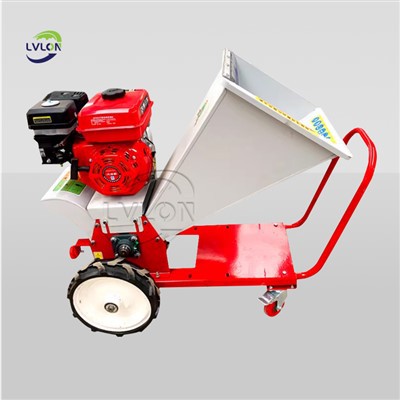
Two Inlets, Two Materials
The large inlet takes big woody material: logs, branches, bamboo trunks. Inside, a cut blade slices them into chips, and the hammers finish the job.
The second inlet takes soft biomass directly - straw, rice husk, grass, corn stalk - straight onto the hammers. No pre-cutting.
The rotor spins at 1450 rpm and generates an air stream that carries crushed material against the screen in repeated collisions. Particles pass the screen only when they fit, so output size holds steady.
Even feeding, even discharge. The chamber does not clog between the two material types.
Models LLS500 to LLS1000
| Model | Power (kW) | Speed (r/min) | Capacity (t/h) | Blades | Dimensions LWH (mm) |
|---|---|---|---|---|---|
| LLS500 | 18.5 | 1450 | 0.5-0.8 | 4 | 2300×1000×1160 |
| LLS600 | 22 | 1450 | 0.8-1.0 | 4 | 2060×1100×1450 |
| LLS800 | 37 | 1450 | 1-2 | 4 | 2616×1584×1290 |
| LLS1000 | 55 | 1450 | 2-4 | 4 | 2500×1360×1550 |
Screens are selected against the downstream requirement. Blade count: four per machine. Structure is compact and the operation is straightforward.
How the Cut-and-Crush Cycle Works
Large woody material gets sliced into short pieces first, then fed through the small inlet. The cut blade segments it; the hammers hammer it down.
Soft biomass skips the blade stage and enters through its own inlet, straight onto the hammers.
Inside the chamber, the rotor throws material against the screen at speed. Fragments rebound into the hammer path and get struck again. Only particles smaller than the screen holes escape.
The loop repeats until the batch passes. Output stays within the 3-5mm window as long as the screen and blades are in good order.
Where the Sawdust Goes
Wood pellet plants run this crusher ahead of the pellet mill - 3-5mm is feed-ready size for ring die pellet machines. Biomass briquette plants press the same output into blocks. Paper mills, fiberboard factories and density board plants use it for chip preparation. Wood powder factories take the finer screens. Furniture factories crush their own offcuts instead of paying for disposal.
Screen Sizes and Output Control
Screen choice sets the sawdust size, and the size must match what the downstream machine expects.
Large woody material gets pre-cut into short lengths before the small inlet - oversize logs clog the chute.
Soft and hard materials run in separate batches for stable output size.
Blade wear shows up as falling capacity; check the four blades on plan.
New blades seat correctly before the load goes on.
Daily Checks
Rotor balance and hammer wear: inspect per schedule.
Screen tension and hole condition: a torn screen sends oversize straight through.
Bearings: grease per plan; investigate new noise the day it appears.
Blade bolts: torque check after every blade change.
Frequently Asked Questions
Q: Can one machine handle logs and straw together?
Yes - that is the point of the two inlets. Logs, branches and bamboo run through the blade path; straw, rice husk and grass go through the hammer inlet. Batch by material for a stable output size.
Q: What size does the sawdust come out?
3-5mm as standard, set by the screen. Screens are changeable, so the output follows the downstream pellet mill or briquette press.
Q: Which model fits a two-ton-a-day wood pellet line?
Two tons over an eight-hour shift averages 250 kg/h - the LLS500 (0.5-0.8 t/h) covers it with margin. Pellet lines running double shifts move up to the LLS800 (1-2 t/h).
Q: Can logs go straight in?
Large trunks get cut into short pieces first, then fed through the small inlet. Whole long logs clog the chute.
Q: Does it need steam or water?
No. This is a dry crushing process - no steam, no water, no boiler.
Q: What powers it?
Electric motors: 18.5 kW to 55 kW across the four models, 1450 r/min fixed speed. No diesel version is listed for this series.
Q: How many blades does it carry?
Four cut blades per machine, working with the hammer set.
Q: What raw materials does it take?
Logs, branches, bamboo, corn stalk, wheat straw, rice straw, rice husk, coconut shell, cotton stalk, grass and garden waste - woody and soft biomass in one machine.
Henan Lvlon Machinery - China-based manufacturer of feed pellet production lines.
Contact Lvlon for model selection, factory wholesale price, distributor terms and container loading plan.