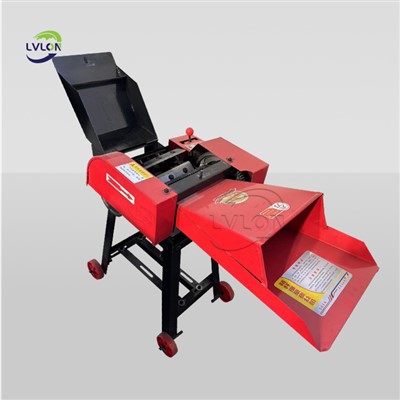
As a chaff cutter supplier, I've spent countless hours on farms, in feed mills, and chatting with livestock operators who run into avoidable headaches when cutting forage: jammed blades, uneven cuts, spoiling silage, and wasted time. More often than not, the root of these issues isn't the machine itself-it's the moisture content of the fodder when it hits the cutter. I want to break down exactly what that number should be, why it matters, and how getting it right turns a good chaff cutter into a workhorse that saves you money.
First, let's get clear on moisture content (MC) because it's not just "how wet the fodder feels." Moisture content is the percentage of water by weight in the plant material, calculated by taking the weight of water, dividing it by the total weight of the fodder, and multiplying by 100. For chaff cutter operators, this number determines everything from blade lifespan to how your final feed performs for cattle, sheep, or dairy herds. I've seen operators with a perfectly high-quality alfalfa crop jam their chaff cutter so bad they had to replace a $200 blade set just because they cut it when it was 15% too dry. On the flip side, cutting at 65% MC meant their haylage fermented too slowly and went moldy within two weeks.
So what's the sweet spot? Most agricultural extension resources I've leaned on point to a range of 45% to 55% moisture content for dry hay or silage chaff cutting. Wait, 45% to 55%-it's a wide window, right? That's because the exact number shifts a tiny bit based on what kind of fodder you're cutting and what you're using the chopped feed for. Let's break it down by common forages I see customers working with.
If you're cutting corn stalks or small grain straw for dry hay, you're looking at the lower end of that range-45% to 50% MC. Corn stalks, when too dry (below 40%), are brittle; they shatter instead of cutting clean, which sends fine dust everywhere and means the chopped pieces are inconsistent. That uneven cut also messes up fermentation if you're making silage later. Last year, a customer from Iowa told me he tried cutting dry corn stalks at 38% MC and his chaff cutter's blades were dull after three days-way faster than the normal two weeks they last. When he adjusted to 48% MC, blade life doubled and the chopped pieces were a uniform 1 to 2 inches, perfect for his beef cattle's ration. For someone harvesting corn specifically for silage, you might use a Self-propelled Corn Silage Harvester to get that exact moisture at the right time, then pass it through your chaff cutter to ensure consistent chop length, which helps with packing and fermentation later. This is key because even a great harvester's output needs a reliable chaff cutter to refine it into uniform feed.
For alfalfa, timothy grass, or other leafy hays, you can lean toward the higher end of the 45-55% range-50% to 55% MC. Leafy hays have more tender stems that handle a little extra moisture without getting mushy. Cut alfalfa too dry (over 55%, wait no-too dry would be below 45% here) wait, let me correct that: cut alfalfa at 55% MC is ideal for haylage, which retains more nutrients than dry hay because you don't have to cure it as long. I work with a dairy farm in Wisconsin that uses our Vegetable Chopper for Animal Feed to process leafy alfalfa and even leftover vegetable scraps, since those need a bit more moisture to chop evenly without turning into pulp. When they tried cutting alfalfa at 58% MC, the leafy parts clumped together in the chaff cutter, and they had to stop every hour to clear the hopper. Dialing it back to 52% MC fixed that, and their haylage fermented with less spoilage, saving them 10 hours a week that used to go to unclogging the machine.
If you're working with forage for sheep, goats, or small ruminants, you can stay right in the middle of that range-48% to 52% MC. Smaller animals need finer, more consistent cuts, so moisture level keeps the stems flexible enough to chop into small, uniform pieces without sticking. I also recommend checking moisture twice a day, especially during haying season. Morning dew adds 5% to 8% moisture overnight, so cutting too early when dew is heavy can push you over 55% MC, leading to moldy feed. Last spring, a customer in Ohio tried cutting grass at 6 a.m. with heavy dew, and their grass chop came out soggy and packed too tightly-their cattle wouldn't eat it because it didn't breathe properly. They started waiting until 10 a.m., when the dew was gone, and adjusted their chaff cutter's gap to match, which fixed the issue. For large-scale forage operations, a Compact Self-Propelled Forage Harvester can also help you time harvest for optimal moisture, but pairing that with a reliable chaff cutter ensures the final product is usable for your herd.
Now, what happens if you're outside that 45-55% window? Let's cover the two extremes: too dry (below 45% MC) and too wet (above 55% MC).
Too dry fodder (under 45% MC) is the most common mistake I see with small to mid-sized farms. Dry forage is brittle, so when you run it through a chaff cutter, the stems shatter instead of cutting, creating a lot of fine dust and inconsistent piece lengths. That dust is not just a waste of nutrients-it can also be a fire hazard in enclosed feed storage areas. More importantly, a brittle feed is hard to pack for silage, which means air gets trapped, leading to bad fermentation and spoilage. The machine takes a beating too: dry fodder doesn't lubricate the blades or the internal gears, so they wear out faster, and the extra force needed to cut brittle stems can jam the cutter's auger or motor. I once had a customer with a small chaff cutter jam so bad he had to call a repair technician at 8 p.m. during harvest season-cost him $250 in emergency service and a full night lost to fixing the machine, all because he skipped checking moisture and cut when his hay was only 40% MC.
Too wet fodder (over 55% MC) is another problem, especially for silage. Excess moisture means the chopped feed is too dense, so it doesn't ferment properly-lactic acid levels drop, and mold and bad bacteria thrive, turning your feed into something that's unsafe for livestock. A wet fodder also clumps in the chaff cutter, sticking to blades and augers, which causes clogs that stop production. I've seen operators with perfectly good chaff cutters sit idle for hours because their silage was too wet, turning a day's work into a day of frustration. Even if you're making dry hay, cutting when it's over 55% MC means you'll have to spend extra time drying it out, which adds fuel and labor costs. Some farms will use a Single Row Silage Harvester to harvest at optimal moisture, then let the forage air-dry slightly before chopping with a chaff cutter, which balances moisture without wasting harvest time.
Wait, is there any exception to this 45-55% rule? Yes-if you're cutting straw for bedding, not animal feed. Straw can be drier (15-20% MC) because it doesn't need to ferment or be palatable for livestock; it just needs to be chopped into long, fluffy pieces that absorb moisture in barns. But if you're cutting straw to mix into your feed ration, you'll want to bring it up to 45% MC by misting it with water first, so it mixes evenly with other forages and doesn't cause digestive issues in cattle. Another exception: very fine forages, like clover, which can be cut at slightly lower moisture (42-48% MC) because their soft stems don't jam as easily.
So how do you measure moisture content? You don't need a fancy lab test for most small operations. A quick, reliable field test is the squeeze test: grab a handful of forage, squeeze it tightly in your fist for 10 seconds, then release. If water drips out or you can squeeze liquid from the stems, it's over 55% MC-too wet. If the stems snap when you bend them, it's under 45% MC-too dry. If the fodder stays in a clump when you open your hand, feels slightly damp but not soggy, and the stems bend without snapping, that's right in the 45-55% range. For a more accurate reading, you can pick up a portable moisture meter for under $100, which takes a reading in 30 seconds-worth the investment if you're harvesting 10+ acres of forage a year.
As a chaff cutter supplier, I tell every customer that a good machine is only as good as the forage you put into it. That's why we design our chaff cutters to work best within that 45-55% moisture range, with adjustable blade gaps and auger speeds to handle slight variations. If you're running a small farm with a few head of cattle, a Grass Cutter for Animal Feed paired with regular moisture checks will give you consistent, usable feed without the headaches. For larger operations, pairing your harvester (like the Self-propelled Corn Silage Harvester or Compact Self-Propelled Forage Harvester) with a high-quality chaff cutter ensures your final feed is uniform, ferments well, and saves you time and money on repairs and spoiled feed.
At the end of the day, getting moisture right isn't just a rule-it's a way to make your livestock's feed more nutritious, reduce machine wear, and cut down on waste. If you're still struggling with your chaff cutter, or you're looking to upgrade to a machine that's built to handle your forage's moisture levels, feel free to reach out for a consultation tailored to your operation's needs.
References:


- USDA Natural Resources Conservation Service. (2021). Forage Harvesting and Storage Guidelines. United States Department of Agriculture.
- American Society of Agricultural and Biological Engineers. (2020). Standard Practices for Chaff Cutter Operation and Maintenance. ASABE.
- University of Wisconsin Extension. (2022). Moisture Content for Silage and Hay: Optimal Ranges and Testing Methods. University of Wisconsin-Madison.
- National Cattlemen's Beef Association. (2021). Livestock Feed Management Best Practices. NCBA.