Lvlon is a machinery manufacturer in Henan, China, building the 1.5 TPH palm waste pellet plant for palm oil mills, palm plantations and biomass fuel plants across Southeast Asia, Africa and Latin America-the palm-growing belt where EFB and PKS are the largest waste stream. As the factory, we supply wholesalers, bulk buyers, distributors and agents directly-no middle layer. In-house fabrication of every stage. One supplier, one warranty. OEM/ODM on die size and configuration, with your brand or specification. Spare parts stocked and air-freighted in 5–15 days.
The Hardest Feedstock in Biomass
Palm waste is three materials, none of them easy. Empty fruit bunch (EFB) is long, fibrous and arrives at 60–70% moisture-the output of every palm oil mill, piling up by the tonne. Palm kernel shell (PKS) is hard, dense and burns at 4,500–4,800 kcal/kg-the premium pellet feedstock. Palm trunk and branches are thick, woody and tangled. A sawdust line runs four stages; a palm line runs five, because the first job is simply reducing the material to a size a hammer mill can handle.
Five Stages, Sized for Palm
| Stage | Equipment | Key spec | Power | Rating |
|---|---|---|---|---|
| Chipping | BX215 drum chipper | 2 knives, 592 rpm | 45+3+3+1.5 kW | 3–4 t/h, chips ~30 mm |
| Crushing | ZW60B water-drop hammer mill | 112 hammers, 87 m/s | 55/75 kW | 1.5–2.5 t/h |
| Drying | GX1500 rotary dryer | Ø1.5m×12m | 7.5+18.5+1.1 kW | 2–2.2 t/h |
| Pelletizing | MZLH508 ring die mill | die Ø508mm, 2 rollers Ø190mm | 90+2.2 kW | 1.5 t/h, 6/8/10 mm |
| Cooling | SKLN2.5 cooler | 2.5 m³ | 0.75+0.55 kW | 2–3 t/h, 6–10 min |
| Packing | WDCS-50 packer | PLC control | 2.2 kW | 3–4 bags/min, 5–50 kg |
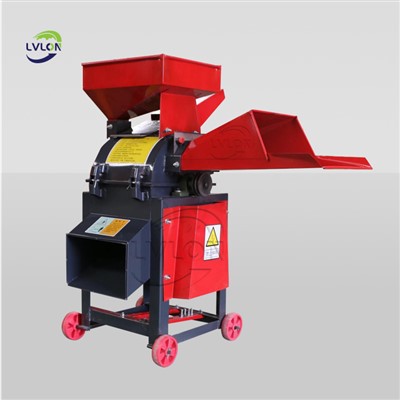
The BX215 drum chipper-sitting on a high-strength steel base-cuts EFB and palm branches into 30-millimeter chips. The ZW60B water-drop hammer mill-660-millimeter rotor, 112 hammers, 87 m/s tip speed-grinds the chips into powder; the water-drop chamber shape flows better than a round chamber and resists clogging. The GX1500 dryer is the largest in the lineup: 1.5 meters diameter, 12 meters long, 18.5 kW induced-draft fan, matched to the 60–70% incoming moisture of EFB. The MZLH508 pellet mill-508-millimeter die, the largest ring die in the plant range-compresses the dried powder at 1.5 tonnes per hour, with aerodynamic cooling keeping the chamber at around 90°C to protect the rollers and die. The SKLN2.5 cooler and WDCS-50 PLC-controlled packer finish the line.
EFB and PKS: One Line, Two Products
The same line produces two different pellets from two different palm wastes. EFB pellets: fibrous, 3,800–4,200 kcal/kg, higher ash-industrial boiler fuel. PKS pellets: dense shell, 4,500–4,800 kcal/kg, low ash-premium fuel for export. A palm oil mill runs both feedstocks through the same line and sells to two markets. The PKS pellets command the higher price; the EFB pellets turn the largest waste stream into revenue.
FAQ
Q: Why five stages?
Palm waste arrives as bulk chunks-EFB strands tens of centimeters long, PKS shells, palm branches. The drum chipper cuts them to 30-millimeter chips; the water-drop hammer mill grinds the chips to powder. A sawdust line skips those stages because sawdust is already powder. Palm waste is not.
Q: EFB pellets or PKS pellets?
EFB: fibrous, 3,800–4,200 kcal/kg, higher ash-industrial boiler fuel. PKS: dense shell, 4,500–4,800 kcal/kg, low ash-premium export fuel. One line makes both. Choose the feedstock mix by market price.
Q: Which pellet line for my feedstock?
Palm waste (EFB, PKS, palm trunk/branches): this line-1.5 t/h, five stages, 508mm die. Sawdust/wood chips: the sawdust or pine line-1 t/h, four stages. Straw: the straw line-1 t/h, five stages with hammer mill. Coconut shell: the coconut line-500 kg/h, five stages with airflow dryer.
Contact Lvlon for the complete line quotation, plant layout drawing and container loading plan.