



Lvlon makes pig farming equipment in Henan, China. The nursery pen system ships to commercial swine operations across Southeast Asia, Africa and South America. In-house steel fabrication, PVC panel forming and assembly. Factory-direct pricing. Full OEM on pen dimensions, panel material, flooring spec and feeder configuration.
The Week After Weaning Is Won or Lost on Temperature
A piglet leaves the sow at about three to four weeks of age. For the previous month, it slept pressed against a 38–39°C sow belly. That heat source disappears on weaning day. The piglet's body-about 6–8 kg, almost no fat insulation, a digestive system that has never processed solid feed alone-now lies on whatever floor the nursery pen provides.
Concrete flooring has roughly 50–100 times the thermal conductivity of plastic. A piglet's belly pressed against cold concrete loses body heat faster than its metabolism can replace it. Core temperature drops. Gut motility slows. Undigested feed sits in the intestine and ferments. Diarrhea starts. Dehydration follows. A piglet that weighed 7 kg on Monday weighs 5.5 kg on Thursday and is dead by Saturday.
This chain-cold floor → gut stasis → diarrhea → death-is the single largest cause of post-weaning mortality. Antibiotics treat the diarrhea. The floor temperature prevents it. The plastic slatted floor on this pen is not a cost-saving substitution for concrete. It is the primary disease prevention tool in the pen. A piglet's belly against warm plastic stays warm. The gut keeps moving. Feed digests. The piglet grows.
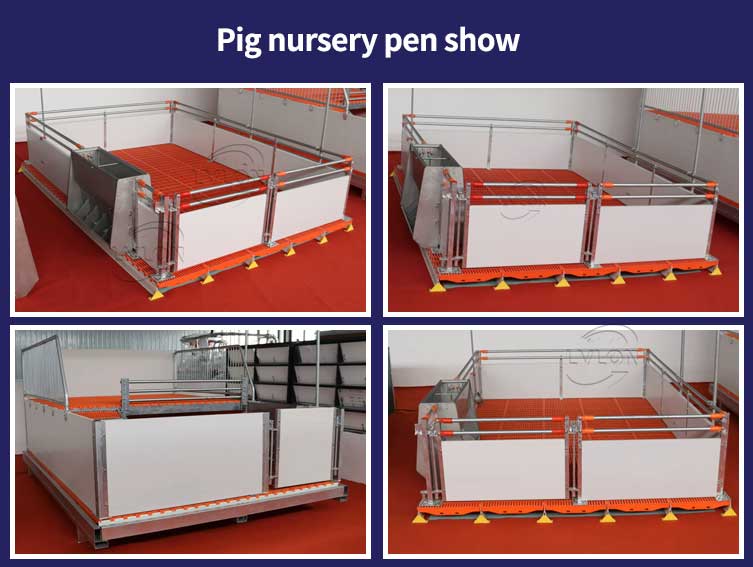
PVC Panels Hold Heat. Steel Holds Structure. Each Does Its Job.
An all-metal pen wall in a 25°C nursery room has a surface temperature around 18–20°C. Piglets huddle against the walls for comfort and lose heat through conduction. An all-plastic pen wall is thermally better but structurally weak-10 piglets shoving against a plastic panel will bow it outward within weeks.
PVC panels provide the thermal barrier and the smooth, non-porous surface that washes clean between batches. The hot-dip galvanized steel frame provides the structural rigidity. The PVC panels bolt onto the frame. The frame bolts to the floor and to the adjacent panels. Neither material is asked to do the other's job.
The frame carries a zinc coating thick enough to outlast the plastic parts around it. PVC panels last roughly 8–12 years under normal wash-down and disinfectant exposure. The galvanized frame is rated for 15–25 years. When the PVC panels eventually need replacement, they unbolt from the still-sound frame and new ones bolt on.
Double-Sided Feeder: Both Sides Eat at Once
Single-sided troughs create a feeding hierarchy within days of weaning. The dominant piglets claim the center positions and stay there. The subordinate piglets circle behind, dart in for a mouthful, get displaced, circle again. After the first week of nursery, the weight spread within the pen is already widening-the pigs that eat grow, the pigs that wait do not.
A double-sided feeder puts feed troughs on both sides of the pen divider. Half the piglets eat from one side, half from the other. A dominant pig on side A cannot physically monopolize a feeding position on side B because the divider wall separates them. The effective feeding stations per pen double without increasing pen floor area.
The trough body is 304 stainless steel. Nursery feed is acidified to roughly pH 4.5–5.5 with organic acids that suppress pathogenic bacteria in the piglet's gut. That same acid slowly etches galvanized or painted steel troughs. Stainless steel does not react. The trough outlasts the pigs by a decade.

Specifications
| Parameter | Spec |
|---|---|
| Type | Weaned piglet nursery pen |
| Dimensions | 2,200 × 3,600 × 1,000 mm |
| Pen height | 0.8 m |
| Capacity | 10–12 weaned piglets |
| Panels | PVC + hot-dip galvanized steel frame |
| Flooring | Plastic slatted, 600 × 700 mm per panel |
| Feeder | Stainless steel 304, double-sided |
| Drinker | Drinking bowl |
| Weight | 240–280 kg per unit |
| Package dimensions | 240 × 180 × 105 cm |
| Design life | 15–25 years |
| Factory price | US$330–420 |
| Warranty | 1 year |
| Customization | OEM/ODM (dimensions, panel material, feeder spec) |
Running a Nursery Pen
Temperature in the creep area starts at 28–30°C for the first post-weaning week, then drops 2°C per week to 22–24°C by nursery exit. A thermometer in the pen is worth more than any other monitoring device. Piglet behavior is the backup check: a pile of piglets huddled together means they are cold. Piglets sprawled on their sides with legs extended means the temperature is right.
Do not switch feed on weaning day. The piglet's gut microbiome is adapted to the creep feed it received in the farrowing pen. Continue that same feed for the first three to five days post-weaning. Then transition gradually-replace about 20% of the creep feed with nursery feed every day over five days. An abrupt feed change means gut shock, which means diarrhea, which pulls the nursery pen into the same mortality spiral that the plastic flooring was designed to prevent.
Group piglets by weight. Maximum weight spread within a pen: ±1.5 kg at entry. A pen with a 3 kg spread at entry will show an 8–10 kg spread at nursery exit-the small pigs never catch up.
Maintenance
Between batches, lift the slatted floor panels. Pressure-wash both sides. Check for cracks or brittleness-a cracked floor panel concentrates stress at the crack tip and will split through within days if not replaced. Wipe the PVC panels and galvanized frame. Check all frame welds for fatigue cracks. Descale the drinking bowls monthly-calcium and magnesium deposits harbor bacteria and restrict water flow.
Wear parts: plastic slatted floor panels (5–8 years), drinking bowls (3–5 years), PVC panels (8–12 years), galvanized frame (15–25 years), stainless steel feeder (10–15 years). All stocked at the factory. Order spare floor panels with the initial pen shipment.

FAQ
Q: How many piglets per pen, and for how long?
Ten to twelve piglets from roughly 6–8 kg at weaning to 25–30 kg at nursery exit. Typical nursery period is four to six weeks. Floor space: roughly 0.3–0.4 m² per piglet. Overcrowding shows up as tail-biting-once tail-biting starts in one pen, the behavior spreads to neighboring pens by observation.
Q: Why plastic flooring instead of concrete or metal?
Thermal conductivity is the reason. A piglet's belly on cold concrete loses body heat faster than its metabolism can replace it. Gut stasis follows. Diarrhea follows that. Plastic flooring is the single most effective intervention against post-weaning scours-more effective than most feed additives. It also weighs a fraction of concrete, so one person lifts a floor panel for cleaning.
Q: What is the difference between the PVC panels and an all-metal nursery pen?
PVC panels are warmer to the touch-piglets huddling against pen walls lose less body heat. PVC is non-porous-feces and feed residue wash off faster than from textured metal surfaces. PVC does not conduct electricity-if a heat lamp circuit has a ground fault, a piglet chewing on a PVC panel is safe; a piglet chewing on a metal panel is not. The trade-off is structural-PVC needs a galvanized steel frame for rigidity.
Q: How does the pen ship, and what assembly is needed?
Bolt-together and clip-in assembly. No on-site welding. Slatted floor panels drop onto fiberglass support beams-each panel is light enough for one person to position. PVC panels bolt to the galvanized frame with pre-drilled holes. The feeder and drinker bowl mount to pre-set brackets on the pen walls. Two workers assemble one complete pen in one to two hours. Assembly drawings and video guidance included.
Q: OEM minimum order and customization scope?
Five pens minimum. Pen dimensions to match existing building column spacing, panel material and height, flooring spec, feeder material (SS304 or SS201) and capacity, drinker bowl type-all customizable. Standard models ship in 10–15 working days. OEM orders add 15–20 working days.
Contact Lvlon for factory wholesale price, nursery pen configuration and container quotation.


