


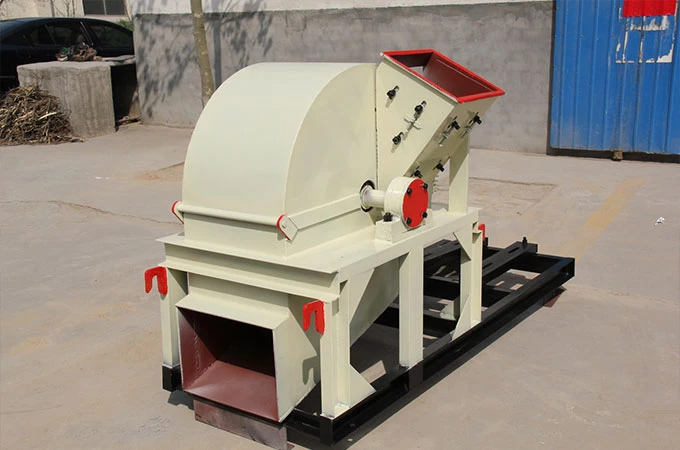
A mechanism charcoal producer we work with spent two years buying sawdust from a nearby mill before deciding to crush his own logs. The crusher he bought first was a conventional single-stage machine, and it gave him exactly what single-stage machines give: coarse chips, a dusty workshop, and a second supplier still charging him for the fine powder his kilns actually needed. The problem was not the machine's build quality. It was the crushing principle - one pass, one reduction, and no way to reach fine powder without adding a second machine.
That is the gap a proper wood sawdust machine closes. This guide uses the numbers from our own wood sawdust machine page - six models from 450 to 1500, capacities from 0.4 to 8 t/h, electric or diesel - to explain how dual crushing works, how the dust problem is solved inside the system, and which configuration fits which plant.
One pass, two crushing actions
A conventional crusher reduces material once. The wood sawdust machine reduces it twice, in the same pass. First, the knives: rotor blades cut logs and branches into pieces. Second, the airflow: the same rotation that drives the knives generates a high-speed air current inside the chamber. The airflow accelerates the material and throws it into repeated impacts - particle against particle, particle against liner. Cutting and impact crushing combined produce the fine wood powder that single-stage machines cannot reach.
The applications that need that fineness are exactly the buyers who come to us: paper mills, edible fungus cultivation, mechanism charcoal plants, panel producers, and dedicated sawdust production bases across Asia, Africa and Latin America. All of them are buying powder, not chips.
The airflow is also the classifier
The second function hides in the same physics. The airflow carries fine material out of the chamber continuously; coarse material stays inside and keeps circulating until it reaches the target fineness. Screening happens inside the machine, in the same process - no separate screen, no second machine, no operator deciding when a batch is done. The fan and discharge piping then deliver the finished powder where the downstream process needs it.
For a buyer, this removes an entire equipment category from the project: the screening and recirculation loop that a single-stage crushing plant has to build separately is already inside the sawdust machine.
Dust control is part of the machine
Fine powder means fine dust, and a dust problem that stops production dead if the workshop fails an environmental inspection. The machine ships with a bag dust collector in the system: dust generated during crushing is captured instead of filling the air, the workshop stays compliant, and operators stay healthy.
The same material flow that grinds the powder also grinds the chamber, and this is where cheap machines fail over time. The wear-resistant liner takes that abuse by design: the liner wears instead of the shell, and replacing a liner costs a fraction of repairing a housing. It is the difference between a machine that lasts and a machine that is rebuilt.
Six models, sized by feedstock volume
The series runs from a 450-model workshop unit to a 1500-model production base. Every model is an integer frame size, and each carries four to twelve knives and a feed opening sized to the logs or branches you will actually feed:
| Model | Knives | Feed opening | Motor | Diesel | Capacity |
|---|---|---|---|---|---|
| 450 | 4 | 120×120 mm | 5.5–7.5 kW | 12–15 hp | 0.4 t/h |
| 650 | 4 | 200×200 mm | 15–22 kW | 22–30 hp | 0.8–1 t/h |
| 750 | 4 | 250×250 mm | 22–30 kW | 30–45 hp | 1–2 t/h |
| 850 | 6 | 300×300 mm | 37–45 kW | 50–75 hp | 2–3 t/h |
| 1050 | 6 | 400×400 mm | 55–75 kW | 75–110 hp | 3–5 t/h |
| 1500 | 12 | 500×500 mm | 90–110 kW | 120–150 hp | 6–8 t/h |
Two selection rules. First, the feed opening has to swallow your raw material: a 450 takes branches that fit 120×120 mm, while the 1500 with its 500×500 mm opening and twelve knives is built for dedicated sawdust production bases chewing real logs. Second, size by tonnage you can secure - the range runs 0.4 to 8 t/h, and a mill fed below its class wastes knives and power alike. Electric or diesel covers the rest: diesel versions work where no three-phase power exists.
Configured to the plant, not the catalog
The frame is only half the order; the configuration is the other half, and it is orderable:
- Feed: horizontal or inclined - matched to the upstream conveyor or a manual loading station.
- Discharge: top discharge air-conveys the powder to bins or silos (and works with the dust system); bottom discharge bags it directly.
- Drive: low- or high-voltage motors to match the local grid; belt drive absorbs start-up shock, direct drive runs at higher efficiency - the large models offer both options.
- Power: electric or diesel engine versions, chosen by what your site actually has.
Send us the floor plan and we recommend the configuration; OEM/ODM on feed, discharge and drive is part of the order, with your brand or specification.
What to check before you pay
- Dual crushing or single stage? Ask directly whether the machine combines knife cutting with airflow impact and built-in classification. If it is a one-stage crusher, it will not reach fine powder without a second machine.
- Is the dust collector in the quote? A sawdust machine without a bag dust collector transfers an environmental compliance problem to your workshop. Ours ships with it in the system.
- Liner or shell? Ask what wears first. A wear-resistant liner is a consumable; a worn housing is a rebuild.
- Feed opening vs your raw material. Match the opening to the logs and branches you actually buy, not to a catalog photo.
- Electric, diesel, or both? Diesel versions cover sites without three-phase power; the large models offer belt and direct drive.
- Terms in writing. One-year warranty, OEM/ODM configuration, spare knives and liners stocked and air-freighted in 5–15 days - ours are, and any serious manufacturer should match that.
Questions buyers ask
Wood sawdust machine or an ordinary crusher?An ordinary crusher gives one stage and coarse output. The sawdust machine combines knife cutting with high-speed airflow impact and screens in the same process - fine powder for mechanism charcoal, MDF and mushroom substrate comes out directly.
How is the dust problem solved?The system includes a bag dust collector: dust is captured during crushing and the workshop stays clean and compliant. The wear-resistant liner keeps noise and maintenance low while it protects the chamber.
Which discharge option should I choose?Top discharge air-conveys the powder to bins or silos and works with the dust system; bottom discharge bags directly. Choose by plant layout and downstream process - send us the floor plan and we recommend the configuration.
Electric or diesel?Electric at your grid voltage for fixed plants; diesel versions in every power class for sites without three-phase supply. The table above lists both for every model.
Summary
A wood sawdust machine is bought for one reason: fine, sellable powder from logs and branches, without a second machine or a dust problem. Dual crushing - knife cutting plus airflow impact with built-in classification - is what delivers that in one pass, and the bag dust collector and wear-resistant liner are what keep it compliant and cheap to run. Size the frame from 450 to 1500 by your tonnage and feed opening, then configure feed, discharge, drive and power to the plant.
Product guide · Lvlon Machinery · Back to hub · Specifications from the manufacturer's datasheet; confirm project-specific details with our engineers.


