



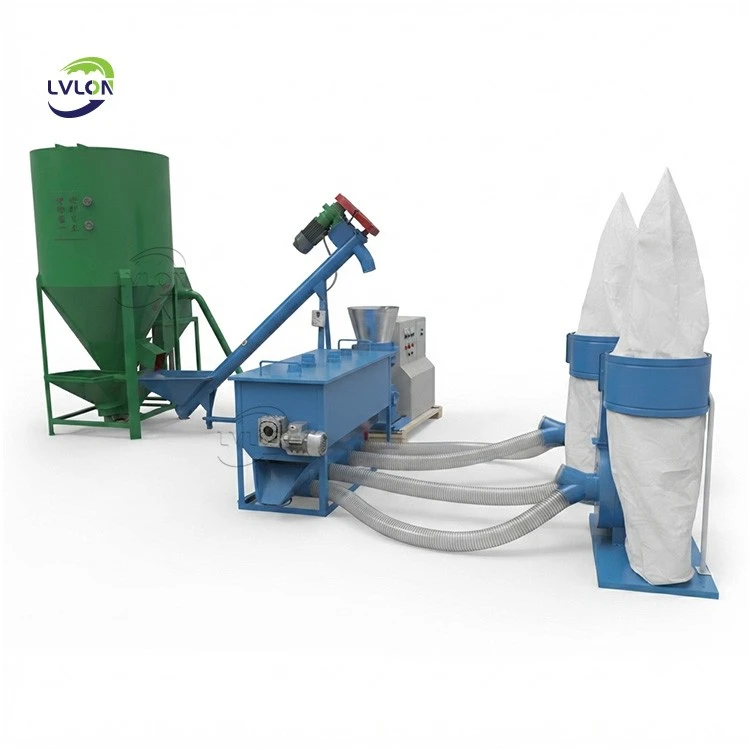

What Problems This Line Solves
Buying commercial pellet feed for a small or mid-size farm eats into margins. Transport alone can add 15–20% to the cost if the nearest feed mill is a hundred kilometers away. And even when you have the ingredients - corn from your own field, soybean meal from the local crusher - turning them into pellets means owning several machines that need to work together. A hammer mill that outpaces the mixer. A conveyor angle that causes bridging. A pellet die that clogs because the powder is too coarse.
This feed pellet line was put together to sidestep those problems. The five machines are sized to each other at the factory, not picked from separate catalogs. The layout is pre-configured. The buyer provides a flat floor, a 380 V supply, and raw materials.

How the Line Processes Raw Material Into Pellets
Material moves through the line under gravity and screw conveyance - no manual transfer between machines.
Grinding stage. Whole corn, soybean meal, straw, or grass loads into the hammer mill hopper. Inside, rotating hammer tips strike the material against a 3–5 mm screen. What passes through is a uniform powder. What stays in the chamber gets hit again. Screen size dictates particle size, which in turn affects how well the pellet die grips the powder later. Coarse particles slip through the die without compressing; excessively fine powder clogs it. During factory testing on corn-soy mixtures, a 4 mm screen has produced the most consistent pellet quality across the 2.5–10 mm die range.
Mixing stage. Powder drops from the hammer mill outlet into a horizontal twin-shaft mixer. Paddles on counter-rotating shafts fold the material into a rolling motion inside the drum. This is where minerals, vitamins, or medication premixes go in. A single-shaft mixer might leave pockets of unmixed supplement; the twin-shaft design halves the mixing time for the same uniformity. For a farmer adding a coccidiostat to broiler feed, half a bag mixed unevenly means some birds get the dose and others don't.
Conveying stage. A screw conveyor lifts the mixed powder from the mixer discharge to the pellet mill inlet. The conveyor motor is independently controlled, so the operator can match feed rate to the pellet mill's current load. A flood of powder onto a cold die is the most reliable way to stall the pellet mill on startup. Slow and steady, especially in the first few minutes.
Pellet forming stage. The flat die pellet mill is the heart of the line. Powder spreads across a stationary flat die plate. Two rollers - mounted on a frame that rotates around the main shaft - press the powder through the die holes. Friction inside each hole generates enough heat (70–85°C) to partially gelatinize grain starch. Pellets emerge warm and slightly soft. They harden as they cool over the next few minutes.
The die plate is interchangeable. Loosen the roller frame bolts, lift the assembly, swap the die, reassemble. A 2.5 mm die produces crumble-sized feed for day-old chicks. A 4 mm die for growers. A 6 mm die for layers and adult poultry. An 8 or 10 mm die makes coarse pellets that ruminants chew properly. Six sizes from one machine.
Cooling and screening stage. Hot pellets drop into a counter-flow cooler. A fan pulls ambient air upward through the pellet bed. Within minutes the pellets reach near-ambient temperature and their hardness stabilizes - the starch that gelatinized during pressing sets firm. A vibrating screen underneath catches broken pellets and powder, which are returned to the mixer inlet for reprocessing. Finished pellets flow to the bagging spout.

Design Decisions Worth Noting
The L-shaped layout isn't just for show. Five machines in a straight line would need about 9 meters of building length. The L-shape folds the line into a corner, cutting the straight-line requirement by roughly a third. In practice, this means a farmer can convert a section of an existing barn or shed rather than putting up a new building.
Nobody likes tracking down five different spare parts suppliers. Every machine in the line - hammer mill, mixer, conveyor, pellet mill, cooler - comes from the same manufacturer. Wear parts across the line ship in one crate. One contact for warranty claims. One set of manuals. For a buyer in a rural area with unreliable mail and a patchy internet connection to browse supplier catalogs, this matters more than a spec sheet can express.
The gearbox gets a longer warranty than the motor for a reason. The pellet mill gearbox runs at low RPM under high torque in a dusty environment - conditions that destroy cheap gearboxes within a season. The factory covers it for five years. The motors get one year, which is standard for industrial electric motors across the industry. The difference tells you where the manufacturer put the engineering budget.
Stainless steel at the contact points, carbon steel for the frame. Feed mixtures are mildly acidic (especially when molasses or silage is in the formula) and slightly abrasive. Stainless steel on the mixer interior and pellet mill contact surfaces eliminates the rust risk. Using Q235 structural steel for the frame and non-contact parts keeps the overall machine cost within reach of a small-farm budget.
What Raw Materials This Line Handles
Corn, soybean meal, wheat bran, rice bran, straw, grass, peanut vine, rice husk, and similar feed ingredients. Raw material moisture should be maintained between 10% and 15%.
Fresh-cut green grass or wet silage will not process properly through the hammer mill - the moisture clogs the screen and wraps around the hammer shaft. Let fresh material dry on a concrete pad for a day or two before feeding it in. A basic grain moisture meter (widely available, inexpensive) takes the guesswork out of this.
Who Uses This Equipment
Self-mixing livestock farms. Poultry, pig, cattle, and sheep operations that currently buy complete feed and want to switch to on-farm production. A line producing 4 tonnes per day covers the daily concentrate needs of roughly 400–500 beef cattle or several thousand broilers.
Farmer cooperatives. A cooperative buys one line, members bring their own corn and crop residues, pay a processing fee, and leave with pelleted feed. This model works in areas where individual farms are too small to justify their own equipment but close enough geographically to share one.
Small-scale commercial feed production. A line producing 500–600 kg per hour can supply a local market of smallholder farmers within a 20–30 km radius. The ability to switch pellet sizes lets a single producer serve poultry farmers, pig farmers, and cattle owners from the same machine.
Crop residue utilization. In regions where maize stover, groundnut haulms, or rice straw are burned or left to rot after harvest, the pellet line converts this biomass into feed inventory. For livestock keepers in areas with pronounced dry seasons - parts of East Africa, the Sahel, inland India - stored pellets bridge the gap when grazing disappears.
Technical Parameters
| Parameter | Spec |
|---|---|
| Model | LLSL260B |
| Brand | Lvlon |
| Capacity | 500–600 kg/h |
| Voltage | 380 V (three-phase) |
| Total weight | 1,650 kg |
| Footprint | 6 × 2.8 × 2.8 m (L-shaped) |
| Die type | Flat die (2.5–10 mm interchangeable) |
| Rollers | 2 |
| Blades | 4 |
| Raw material moisture | 10%–15% |
| Warranty | Motor: 1 year. Pellet mill gearbox: 5 years |
Machines in the Line
| Machine | Model | Power | Function |
|---|---|---|---|
| Hammer mill | LCS420 | 7.5 kW | Grinds grain and straw to 3–5 mm |
| Mixer | LJH500 | 4.0 kW | Blends powders with premixes and additives |
| Screw conveyor | 75YP | 1.5 kW | Feeds the pellet mill at adjustable speed |
| Pellet mill | LLPM260B | 15.0 kW | Presses powder through flat die into pellets |
| Cooler-screener | LQSF50 | 2.2 + 0.75 kW | Cools pellets to handling temperature, screens out fines |
Setting Up and Running the Line
The line ships pre-configured in its L-shaped layout. Marked positions on the layout diagram show where each machine sits. The buyer prepares a flat concrete floor in a space no smaller than about 8 × 5 meters (room for the machines plus operator access on all sides). A 380 V three-phase supply with a main breaker rated for at least 60 A is required.
Startup sequence is not arbitrary. Pellet mill and cooler come on first - the die needs 1–2 minutes of no-load warm-up to reach a temperature where powder grips the holes instead of skating across the surface. Then mixer and conveyor. Hammer mill last. When shutting down, reverse the order so no material is left sitting in the conveyors between runs. Stale powder in a warm, humid machine will mold within a day.
If the pellets come out too hard and brittle, raise moisture slightly by misting water into the mixer. If they crumble straight out of the die, the powder may be too dry or the die holes may have worn smooth - a polished die bore loses its friction grip. A die typically runs 500–800 tonnes before the hole surfaces start to glaze.
Changing pellet diameter means swapping the flat die. Let the machine cool first - a hot die expands and the roller frame bolts are harder to break loose. The whole swap takes about 15–20 minutes. Farms producing multiple feed types typically keep two or three dies on the shelf.
What to Watch For and When to Replace Parts
After each production run, clear the hammer mill screen of stuck particles and check the pellet die for plugged holes. A plugged hole is easy to miss but reduces throughput with every missed opening. Scrape the mixer walls if switching between formulations.
The hammer mill hammers are the highest-wear item. When the striking edge rounds off beyond about a third of the hammer width, rotate to a fresh edge or replace the set. Hammers typically last 200–400 tonnes of material. The pellet die wears more slowly (500–800 tonnes), but a worn die announces itself with lower throughput, softer pellets, and more powder in the screened returns. Rollers wear faster than dies - 300–500 tonnes - because they take the direct abrasion from the powder layer.
The factory stocks all wear parts: hammers, screens, dies of all standard sizes, rollers, and mixer paddles. Order a spare die and hammer set with the machine to avoid downtime waiting for air freight later.
FAQ
Q1: I only have single-phase power on my farm. Can I use this line?
Q2: I have been feeding my pigs mash (ground powder). Why should I pellet it?
Q3: Can I process fresh green grass through this line?
Q4: What else do I need to budget for beyond the machine itself?
Q5: Do you send someone to install it?
Q6: Can I put my own company name on the machine?


