



Automatic Ring Die Pellet Machine
Product Overview
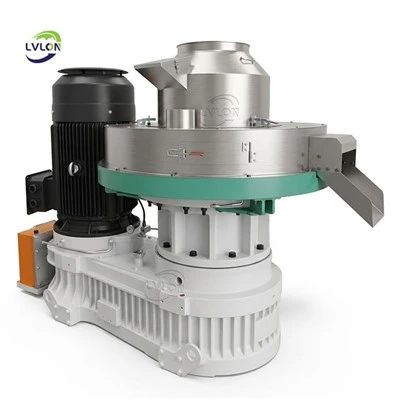
The Industrial Automatic Ring Die Pellet Machine is a heavy-duty industrial pelletizing system engineered for the continuous, high-volume production of biomass fuel pellets (wood, agricultural stalks) and commercial animal feed. Built for large-scale processing facilities, this equipment integrates automated feeding, PLC-based process control, and forced lubrication to minimize manual intervention and stabilize output over multi-shift operations.
Unlike small flat-die units designed for farm or household use, this equipment utilizes a rigid ring die and a high-speed rotating roller assembly to generate the high mechanical compression required for dense, uniform industrial pellets.
Core Technical Features
Automated Feeding & PLC Control
• System Integration: Features an integrated variable-frequency screw feeder synchronized with a PLC control unit via a central touchscreen interface.
• Operational Control: Automatically adjusts material feed rates based on main motor current load to prevent choking or overloading.
• Safety & Monitoring: Real-time digital monitoring tracks bearing temperature, gearbox oil pressure, and motor load, triggering immediate shutdowns and diagnostic error codes if anomalies occur.
High-Throughput Industrial Performance
• Capacity Matrix:
Compact Industrial (Model 350/420): 0.8 to 2 tons/hour (suitable for medium feed mills or smaller wood pellet plants).
Mid-Scale Industrial (Model 508): 2 to 5 tons/hour.
Heavy-Duty Industrial (Model 558/678): 5 to 10+ tons/hour.
• Continuous Duty Cycle: Engineered for 24-hour continuous operation with forced air-cooling or oil-cooling heat exchangers for the main gearbox.
Precision-Engineered Ring Die & Roller Assembly
• Metallurgy: Ring dies are manufactured from forged X46Cr13 stainless alloy steel or alloy structural steel, subject to deep-hole CNC gun drilling and vacuum heat treatment to achieve a uniform working hardness of HRC 52–58.
• Compression Geometry: Die compression ratios are custom-machined (ranging from 1:4 to 1:8) matching the lignin content of specific biomass or the protein density of feed formulations.
• Roller Design: Alloy steel rollers feature a specialized tooth or corrugated surface profile to prevent material slippage and ensure an even distribution of material across the internal die face.
Direct-Drive Transmission System
• Power Train: Utilizes a high-precision helical gear transmission box driven by an industrial-grade electric motor (IE3/IE4 energy efficiency standards).
• Efficiency: Eliminates the slip and power loss common in belt-drive configurations, transferring over 95% of motor torque directly to the main shaft.
Automated Forced Lubrication System
• Operation: An electric grease pump automatically injects high-temperature lithium-based grease into main shaft bearings and roller assemblies at programmable time intervals (e.g., every 30 minutes).
• Maintenance Impact: Eliminates manual greasing errors, prevents bearing micro-seizure under high thermal loads, and extends component service life.
Technical Specifications
|
Parameter |
Specification Details |
|
Machine Type |
Industrial Automatic Ring Die Pellet Machine |
|
Target Applications |
Biomass wood pellets, agricultural waste pellets, livestock/poultry feed |
|
Output Capacity |
0.8 to 10+ tons/hour (dependent on model and raw material) |
|
Pellet Diameter Options |
2 mm to 12 mm (exchangeable ring dies) |
|
Main Motor Power |
55 kW to 315 kW (Customized based on model size) |
|
Die Material |
Forged X46Cr13 stainless alloy steel / Cr alloy steel |
|
Control Architecture |
PLC touch-screen automation with VFD material feeding |
|
Lubrication System |
Programmable automatic electric grease injection |
|
Structure & Compliance |
Cast iron/steel welded base frame with hardened alloy steel gearing; CE & ISO9001 Certified |
Raw Material Processing Parameters
To achieve optimal throughput and structural pellet integrity, raw materials must meet strict preprocessing thresholds:
Moisture Content:
• Biomass: 12% to 15% (requires rotary drum drying if raw moisture exceeds this range).
• Feed: 13% to 16% (conditioned via a stainless steel multi-layer steam conditioner).
Particle Size:
2 mm to 5 mm (achieved via industrial hammer mills or wood chippers).
Acceptable Feedstocks:
• Biomass: Pine, oak, eucalyptus sawdust, rice husk, wheat/rice straw, palm empty fruit bunches (EFB), bamboo dust.
• Feed: Corn meal, soybean meal, wheat bran, alfalfa grass meal, mineral premixes.
Main Application Fields
Biomass Energy Plants
Conversion of forestry residues and wood waste into high-density industrial fuel pellets for power generation and district heating boilers.
Commercial Feed Mills
High-efficiency production of pathogen-free, gelatinized compound feed pellets for poultry, swine, and ruminant livestock.
Agricultural Recycling Operations
Processing agricultural by-products (straw, stalks) to transform agricultural waste into storable bio-energy commodities.
Factory Quality Control & Inspection Protocol
Every machine undergoes a rigorous multi-stage quality assurance procedure prior to crating and export:
Raw Material Metallurgical Testing: Spectroscopic analysis of alloy steel blocks used for ring dies and main shafts.
Machining Precision Verification: CMM (Coordinate Measuring Machine) inspection of die hole depth, taper, and concentricity.
Dynamic Balancing: High-speed dynamic balancing tests performed on the main rotor assembly and gear shafts to eliminate vibration.
No-Load & Full-Load Test Run: 4-hour factory running test monitoring motor amperage draw, gearbox operating temperature, and automatic lubrication flow rates.
Global After-Sales Support & Spare Parts Management
Dedicated Engineering Assistance: Comprehensive remote diagnostics via PLC interface and global on-site technical deployment for installation and commissioning.
Wear Part Availability: Readily stocked high-durability ring dies, rollers, and bearings dispatched with expedited global logistics to minimize facility downtime.
Preventative Maintenance Plans: Tailored schedules and operator training modules to maximize component lifespans under heavy-duty 24/7 operating conditions.
Frequently Asked Questions
Q: What materials can be processed by an Automatic Ring Die Pellet Machine?
A: The machine can process biomass materials such as sawdust, wood chips, straw, rice husk, bamboo powder, and agricultural residues. It can also produce animal feed pellets using grain-based mixtures. Final performance depends on material moisture, particle size, and formulation.
Q: What is the difference between a ring die pellet machine and a flat die pellet machine?
A: Ring die pellet machines are engineered for heavy-duty, industrial-scale production with higher output capacity and 24-hour continuous operation. Flat die machines are typically restricted to small-scale production, farms, or household applications. Ring die units are necessary for stable, high-volume commercial manufacturing.
Q: What production capacity can this machine achieve?
A: Capacity depends on the specific machine model, raw material characteristics, moisture content, and target pellet size. Standard industrial configurations deliver anywhere from 0.8 tons/hour to over 10 tons/hour.
Q: How long does the ring die normally last?
A: The service life of the ring die is dictated by raw material abrasiveness, operating conditions, and maintenance routines. Utilizing properly dried and screened feedstock combined with the automated lubrication system significantly extends working longevity.
Q: Does the machine require skilled operators?
A: The integrated PLC touch-screen control architecture simplifies daily operations significantly. Operators primarily require training focused on material preprocessing quality control, parameter setup, and scheduled routine maintenance.
Hot Tags: automatic ring die pellet machine, China automatic ring die pellet machine suppliers, factory, Silage Baler Machine
You Might Also Like




Send Inquiry